We are living longer, and our societies are ageing — which quietly changes the most important question a person asks in their late fifties. It is no longer only how long, but where and how those added years will be lived. A growing number of Northern Europeans, at fifty-five or sixty, are answering with a place rather than a plan: the Costa Blanca. They are moving not to retire out of sight, but to spend the longer life they can now expect somewhere that makes it worth having — a coast that stacks the quiet fundamentals of ageing well into a single, ordinary day, inside a country whose life expectancy reached 84.0 years in 2024, among the three highest in the European Union.
There is an uncomfortable subtext to the trend, and it is worth naming. Across much of Northern Europe the rise in life expectancy has stalled, and the years lived in good health have, in places, begun to slip — Scotland’s healthy life expectancy fell from 62.8 to 61.4 years over recent measurement periods, and the wider European study of 2025 found flat or negative movement in several Western nations, the Netherlands the only one to record an outright decline. People sense this before they read it. The instinct to relocate for the second half of life is, at bottom, an instinct to reclaim the inputs — sun, movement, a better table, calm — that the north increasingly struggles to provide. The Costa Blanca is where that instinct keeps landing.
The market context confirms that the appetite is real and moneyed. Knight Frank’s Wealth Report 2026 records prime residential prices rising 3.2% globally and 3.3% across Europe in 2025, with 73 of the 100 tracked markets gaining — evidence of Spain’s strengthening global appeal rather than a local blip. Sotheby’s International Realty’s 2026 Mid-Year Luxury Outlook adds the motive behind the money: close to 38% of professionals working above the ten-million-dollar mark now cite «aging in place» as a growing factor in purchase decisions, and the global longevity market is projected to grow from around US$5.3 trillion in 2023 toward US$8 trillion by 2030. But a figure describes a movement; it does not explain why this particular coast keeps winning the comparison. The reasons are worth setting out plainly.
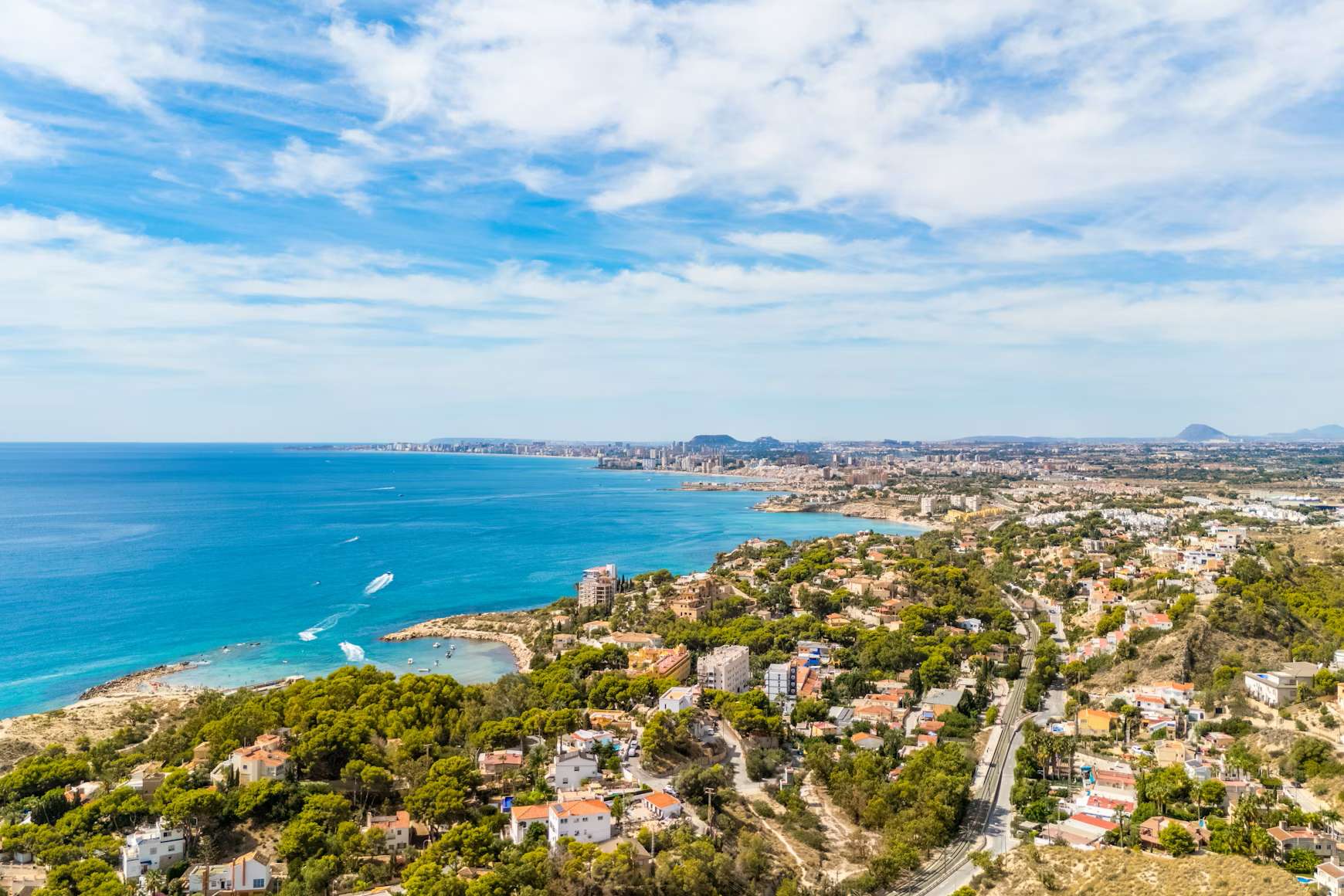
It begins with climate — and here the Costa Blanca is not simply another sunny coast, but a genuine microclimate. It offers more than three hundred days of sunshine a year, with average temperatures moving gently between roughly 12°C in January and 28°C in August, mild enough that the body is invited outdoors in February rather than confined for a northern winter. Two features make it distinctive. The salt lagoons of Torrevieja and La Mata release an iodine-rich air long associated with relief for respiratory, rheumatic and skin conditions — a reputation that has followed this coast for generations. And the sea itself is warmer and calmer than the cooler, more variable waters off Catalonia to the north, or the Atlantic-fed Alborán of Andalusia to the south, so walking and swimming by the water become a year-round habit rather than a summer treat. This is not a holiday detail; it is a health input. Longevity science keeps returning to the same unglamorous fundamentals — daily movement, sunlight, time outside — and a coast that makes those effortless does quiet medical work no building can replicate.
Then there is the table. The Mediterranean diet is not a marketing phrase here; it is the local grammar of eating. The Spanish PREDIMED trial — one of the most cited nutritional studies of the last two decades — found that a Mediterranean pattern rich in extra-virgin olive oil and nuts reduced cardiovascular risk by roughly 30% against a low-fat control. A more recent study of older adults in the Valencian Community associated good adherence to that same diet with measurably better quality of life. On the Costa Blanca this is not a discipline imposed on the day; it is what the market stalls, the huerta and the olive groves quietly hand you. The finest longevity protocol in the region is the ordinary lunch.
Safety belongs on the same list, and it weighs heavily for anyone relocating for the long term. Spain is among the calmest countries in Europe — 25th of 163 in the 2025 Global Peace Index, with rates of serious crime among the lowest on the continent. For a couple choosing where to grow older, often far from the family and networks they leave behind, the ability to walk in the evening, to leave a house for the season, to feel unremarkable and at ease, is not a soft benefit. It is a precondition for the open, outdoor life that keeps people healthy. Peace of mind is, quite literally, part of the equation.
Then there is the human infrastructure that no brochure captures. Established international communities, many of whom arrived in groups from the same countries, have kept their social life going here — Germans, Dutch, Scandinavians, British who did not so much emigrate as relocate together, carrying their circle with them and continuing the cultural life of their own nationality on Spanish soil: their language, their customs, their clubs and gatherings, largely intact. For the longevity question this matters more than it appears. Isolation is one of the quiet risks of later life; a coast where one’s own language, friendships, and familiar way of living already exist removes it before it starts. Even the specialists have taken note — the clinic named Best Global Longevity Retreat at the Global Spa Awards 2026 sits on this coast, at El Albir near Altea. It is one more signal, not the reason: the fundamentals were here long before the award.
Two things rarely coexist, and on this coast they do. On one side, it is genuinely developed — mature transport, healthcare and social infrastructure, an international airport at Alicante placing most of Northern Europe within a short direct flight, and no heavy industry to compromise the air or the water; the local economy runs on services, agriculture and tourism, not smokestacks. So a home here means neither distance from children and grandchildren nor a trade-off on clean surroundings. On the other side, it remains unusually accessible: a wide choice of homes across every register, and a cost of living materially below the Costa del Sol — by some measures 35–50% lower — and below the higher-priced stretches of the Costa Brava. One can live well here without the surcharge that «prestige» postcodes elsewhere quietly impose. For a buyer who wants quality without theatre, that combination — developed yet unspoiled, serviced yet affordable — is often the quiet argument that closes the decision.
Around all of this sits a layer that belongs to the advisor rather than the brochure: the legal architecture of staying. A home meant for the rest of one’s life eventually passes to someone. Since May 2023 the Valencian Community applies a 99% reduction on inheritance and gift tax for spouses, descendants and ascendants; from June 2026 that relief begins extending to siblings, nephews and nieces. For an international buyer thinking in decades, this makes the Costa Blanca a place one can commit to and pass on, rather than merely occupy. (Every situation is individual; the final calculation belongs to a lawyer or tax adviser.)
So the answer to the person weighing where to spend a longer life is quieter than a ranking, though the numbers are moving in one direction. The Costa Blanca does not win on a single metric; it wins on the accumulation of small, daily, verifiable advantages — a true microclimate, sun, a warm calm sea, the table, safety, developed infrastructure without heavy industry, a community already in place, real affordability, and a legal frame that lets a home stay in a family. That is why, as lives lengthen and the north’s added years grow harder to enjoy at home, the flow of Northern Europeans keeps thickening — and why it is unlikely to reverse. The rest is a matter of choosing the right house, discreetly — one that will still work as its owner ages — and letting the years, now that there are more of them, be good ones.
FAQ
Why are Northern Europeans increasingly moving to the Costa Blanca after 55–60?
Because lives are lengthening while the northern climate, diet and pace make the added years harder to enjoy at home. The Costa Blanca stacks the fundamentals of a long, active life in one place: a genuine microclimate with 300+ days of sun, a warm calm sea, the Mediterranean diet, safety, developed infrastructure without heavy industry, short flights home, established communities and real affordability — inside a country whose life expectancy reached 84.0 years in 2024 (Eurostat).
What makes the Costa Blanca's climate different from other Spanish coasts?
It is a distinct microclimate, not just a sunny coast. The salt lagoons of Torrevieja and La Mata create an iodine-rich air long associated with respiratory, rheumatic and skin relief, and the sea is warmer and calmer than the cooler waters off Catalonia or the Atlantic-influenced Alborán of Andalusia — making outdoor life a year-round habit.
Is it expensive to live and buy there?
Comparatively, no. The Costa Blanca offers a wide choice of homes and a cost of living materially below the Costa del Sol — by some measures 35–50% lower — and below the higher-priced areas of the Costa Brava, while keeping developed infrastructure and clean surroundings free of heavy industry.
Is the Costa Blanca safe for older residents?
Spain is among Europe's calmest countries, ranked 25th of 163 in the 2025 Global Peace Index, with rates of serious crime among the lowest on the continent.
How is inheritance tax treated for a home here?
Since May 2023 the Valencian Community applies a 99% reduction on inheritance and gift tax for spouses, descendants and ascendants; from June 2026 relief begins extending to siblings, nephews and nieces. Individual cases vary and should be confirmed with a qualified adviser.
Sources
- Knight Frank — The Wealth Report 2026 & PIRI 100: global prime +3.2%, Europe +3.3% in 2025; 73 of 100 markets rising. knightfrank.com, April 2026.
- Sotheby’s International Realty — 2026 Mid-Year Luxury Outlook (report title). PR Newswire, 15 June 2026; Inman, 18 June 2026.
- Eurostat — Life expectancy in the EU, data for 2024 (published Sept 2025): Spain 84.0 years.
- Life expectancy stalling in Northern Europe; healthy life expectancy (Scotland 62.8→61.4); European Life Expectancy Study 2025 (Netherlands −0.2). Springer/PMC 2025; ScienceDaily, Feb 2025.
- Global Peace Index 2025 (Institute for Economics & Peace) — Spain 25th of 163.
- PREDIMED trial — Mediterranean diet and cardiovascular risk (~30% reduction), Spanish cohort; PLOS One / NCBI PMC.
- Mediterranean diet and quality of life in older adults, Valencian Community — NCBI PMC (2025).
- Costa Blanca climate & microclimate — 300+ days sun; Torrevieja/La Mata salt lagoons, iodine-rich air (long-held reputation for respiratory/rheumatic benefit); warmer, calmer sea vs Catalonia/Andalusia. Regional guides & comparisons, 2025–2026.
- Cost of living / property — Costa Blanca ~35–50% below Costa del Sol; below higher-priced Costa Brava. Regional comparisons, 2025–2026.
- SHA Wellness Clinic — El Albir / Altea; Best Global Longevity Retreat, Global Spa Awards 2026.
- Inheritance & gift tax, Comunidad Valenciana — 99% bonificación (from 28 May 2023); Law 5/2025 extending relief to Group III from 1 June 2026. Andersen; Guía Fiscal; Arkakey, 2026.
Legal and tax figures reflect Comunidad Valenciana rules as of 2026 and are general information, not advice; every calculation is individual and should be confirmed by a lawyer or tax adviser. The salt-lagoon microclimate’s health reputation is long-established locally; it is presented here as reputation, not as a specific clinical claim.