
Here is why individuality is not a singular home’s weakness but a factor in its liquidity — and why the public window works against it.
A buyer doesn’t buy square metres. They buy the ability to picture themselves at home
The decision to buy a home is made by projection, not calculation. A person walks in and completes the picture: here is where I drink my coffee in the morning, here is where I work, here is where I receive guests. Professional bodies on both sides of the Atlantic report the same thing: according to the Home Staging Association UK & Ireland (2023) and the National Association of Realtors in the US (NAR, 2023), between 77% and 83% of agents confirm that a neutral, cleared presentation helps a buyer see the property as their future home. Hence the standard pre-sale preparation of ordinary housing: remove the personal photographs, mute the colour, take away some of the objects.
The logic is simple. The more neutral the space, the easier it is for the average buyer to move in mentally — someone with neither the decorator’s experience nor the trained eye to complete a complex interior for themselves. This is how the show units of standard new-builds are arranged. This is how hotels are arranged: contemporary classic without triggers, clean, tidy, recognisable, and deliberately faceless. It isn’t poverty of thought; it is engineering for compatibility with the widest possible audience.
Singularity is not only about the interior
When a person projects themselves, they choose a home by more than the colour of its walls. They choose by their own scale and way of living — and scale here is not about budget, but about how a person is made and how they live. One needs a single open volume where nothing is divided and everything breathes the same air; that is how a loft carved out of a former factory lives. Another needs an enfilade, a sequence of rooms where each scene of life has its own place and its own threshold; that is how an old palace is built. This is not a question of “cheaper or dearer” but of temperament: openness or seclusion, one continuous volume or the ritual of passing from room to room. Singularity is the interior, but also the size, the format, the location and the rhythm of life the house imposes. All of it narrows the circle of “the right people” before decor is even mentioned.
A singular home is built on the opposite principle
A home with character is incompatible with mass-market logic by definition. Its face is not a coat of paint that can be washed off, but part of its substance. And that face usually comes from one of a few sources.
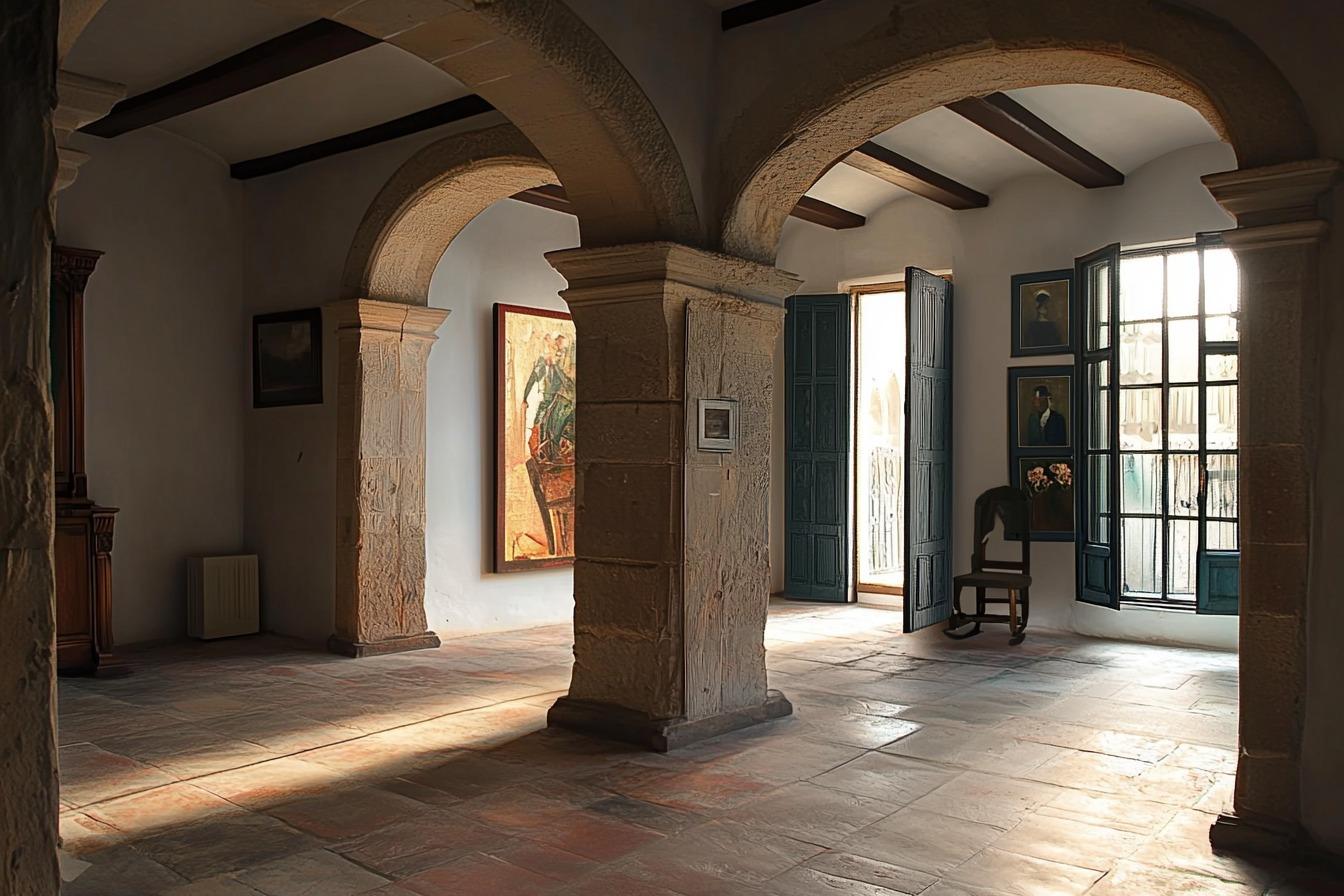
From architecture: when the structure itself — the light, the proportions, the building’s dialogue with the landscape — dictates what the interior can be, and tolerates no accidental furniture. A former church, the shell of an old factory where railway wheelsets were once made, a loft with its load-bearing elements laid bare — these live by their own laws. To live inside such a structure at ease — not fighting, but accepting that your address has a past — takes an inner freedom and a distance from cliché.
From the owner’s personality — and here, though it is rarely said aloud, profession and nationality weigh heavily. Profession gives the space a function: a musician’s home with a recital room, a painter’s studio with north light, a scholar’s library, a restaurant-scale kitchen for someone whose calling is food. The next owner either shares that function or pays for what they do not need. Nationality works more quietly, through cultural codes: restraint and wood for a Scandinavian, light and openness for a Mediterranean, a different handling of colour, symmetry and privacy for an owner from the Middle East. Culture shapes not the ornament but the very logic of the space. None of this makes a home better or worse — but it markedly narrows the circle of those for whom it sounds like home.
From history: when a 17th-century palace, or a house where a well-known figure lived and worked, preserves original details — finishes and objects that witnessed events. Owners usually want to keep such things rather than erase them, and they are right to: provenance is part of the value.
To accept black walls, an abundance of mirrors and gold — or, conversely, raw concrete and brick — as a virtue rather than a reason to renovate takes the same capacity and the same freedom from the template. Not everyone has it. And that is neither good nor bad: there is no arguing about taste. But buyers with that freedom are a handful, not a stream.
What happens when a singular property is posted on a mass-market portal
This is where the conflict arises. A mass-market portal is built for the mass-market buyer. Strong individuality in that window reads not as value but as “everything will have to be redone” — that is, as a hidden surcharge. The portal’s audience is mostly not the recipient who would appreciate that individuality.
Then the mechanics of time set in. In my experience of the market, after roughly three months of public exposure without a sale, a listing begins to be seen as “stale” and to work against itself. A long exposure is read by buyers as a signal that something is wrong with the property, whether or not that is true. The stigma of the stale listing forms, and behind it a predictable spiral: to revive interest, the price must come down, and the market, having seen one reduction, waits for the next. The first meaningful discount on such a property I usually see in the range of 3–5%, and in a cautious market up to 6–8% — and that is before negotiation begins, not as its outcome.
In other words, for a singular home publicity is not free reach but a slow erosion of value. A property that was simply waiting for its buyer starts to look, in public, like a property people are turning down.
Why silence here is an instrument, not a limitation
Selling something authored on a mass-market platform is much like exhibiting a work with provenance at a flea market, or offering a singular, singularly understood wine where it is judged by the price per litre. The problem is neither the wine nor the buyer. The problem is the mismatch between context and recipient.
A private sale resolves exactly that mismatch. The property is not displayed publicly; it is presented directly, to the narrow circle for whom its character is an argument rather than an obstacle. There is market logic to this, not only aesthetics: in Spain, more and more owners of distinctive homes are choosing to sell without wide public exposure, and the quiet, non-public approach — privacy over the shop window — has become a settled preference among a discerning audience. The value of a singular property is preserved by silence: it does not age in the window, does not accumulate a history of reductions, and reaches its buyer without stigma.
Hence a simple conclusion. If you have a home out of the ordinary and you don’t want it to lose value hanging on a mass-market portal for months, publicity is not your ally. You need not maximum reach, but a precise match with the one person already looking for exactly this. That is what Silent Sale exists for.
FAQ
Does this mean a singular home should be "depersonalised" before selling?
As a rule, no. Depersonalisation is a tool for ordinary housing and a wide audience. For a home with character, its face is the argument; the task is not to erase individuality but to bring the right, narrow buyer to the home.
Is singularity only about the interior?
No. Singularity is the interior, but also the scale, the format, the location and the way of living the house imposes. A buyer projects themselves across all of these at once, not by decor alone.
After how long does a public listing start to hurt?
A useful marker is around three months of public exposure without a sale. Beyond that, the length of exposure itself lowers perceived value and invites the expectation of a discount — a typical first reduction of 3–5%, and up to 6–8% in a cautious market.
Is Silent Sale slower than an open sale?
Not necessarily. A private sale is measured not by the number of views but by the quality of the recipient. One prepared buyer, for whom the property reads as if written for them, is often more effective than hundreds of random enquiries.
What determines whether a home needs a non-public format?
Not price, but singularity: the architecture, the authorship, the owner's profession or the history that makes the home incompatible with mass-market logic. Such a property may be priced in many ways — but it sells by different rules.
Legal and tax aspects of any transaction are individual; final verification is always done by a lawyer or tax adviser.